


Human Rights in Armed Conflict: Asian–European Perspectives
Armed conflicts, both international and non-international, have increased significantly in recent years, resulting in serious and widespread human rights violations. Civilians are increasingly exposed to unlawful killings, torture, forced displacement, and destruction of civilian infrastructure. Vulnerable groups, including women, children, minorities, and displaced populations, are particularly affected as legal and institutional protections weaken during hostilities.
International Human Rights Law (IHRL) and International Humanitarian Law (IHL) apply concurrently in situations of armed conflict and establish binding obligations for states and other parties. Serious violations may also constitute international crimes under International Criminal Law, including those under the Rome Statute of the International Criminal Court. International Refugee Law and domestic legal systems further shape the protection framework in specific contexts. Despite these legal regimes, implementation remains uneven due to weak enforcement, limited international cooperation, lack of accountability, and insufficient political will.
Contemporary armed conflicts present new challenges. In non-international conflicts, hostilities are often framed as counter-terrorism operations, limiting the application of IHL protections. At the same time, rapid technological change has transformed warfare. The use of drones, autonomous weapon systems, cyber operations, and digital surveillance tools raises serious legal, ethical, and accountability concerns. Existing interpretations of international law struggle to address new forms of harm caused by cyber and information-based warfare, as well as the potential loss of meaningful human control over the use of force.
Armed conflict also has significant implications for global business and economic activity. Conflict-related disruptions affect supply chains, infrastructure, investment, and market stability. Businesses operating in or linked to conflict-affected areas face increasing expectations to respect human rights under international standards such as the UN Guiding Principles on Business and Human Rights. Failure to conduct effective human rights due diligence exposes companies to legal, financial, and reputational risks.
Media and communication systems play a critical role in shaping public understanding and policy responses to armed conflict. While media coverage can support transparency and accountability, the spread of misinformation and disinformation—particularly through digital platforms—can escalate violence, distort narratives, and obscure human rights violations. Attacks on journalists, restrictions on press freedom, and digital censorship further undermine accountability and public trust.
Asian countries and the European Union (EU), with their diverse legal traditions, economic influence, and strong engagement in multilateral processes, are well positioned to contribute to global efforts to strengthen human rights protection in armed conflict. Both regions face complex security challenges and offer valuable perspectives on balancing security, legal obligations, economic interests, and media freedom.
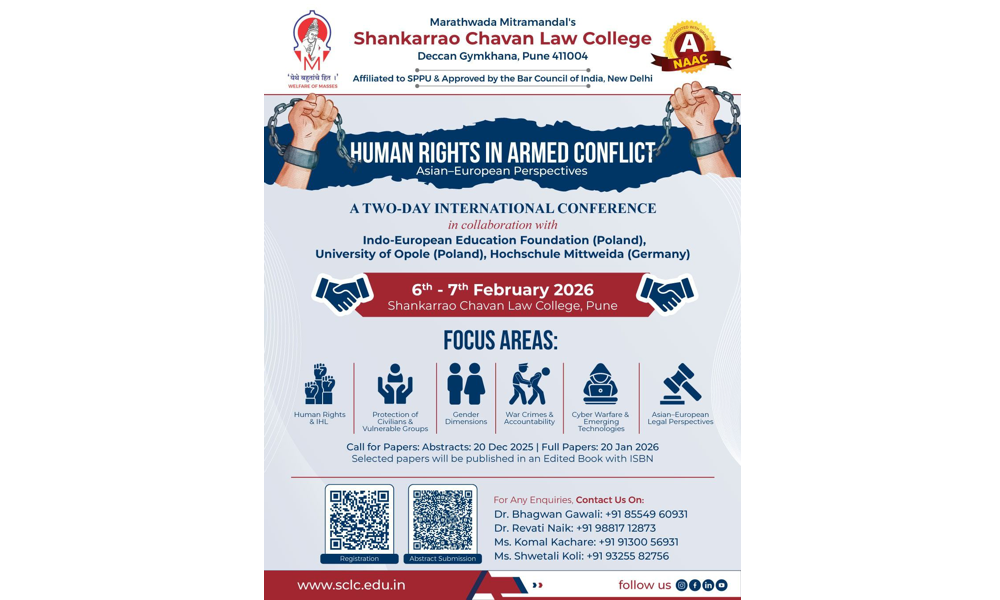
The proposed conference, “Human Rights in Armed Conflict: Asian–European Perspectives,” aims to bring together legal scholars, policymakers, corporate actors, media professionals, and civil society representatives. The conference will promote dialogue, share regional experiences, and develop practical, policy-oriented recommendations to strengthen legal compliance, corporate responsibility, responsible media engagement, and effective governance in conflict situations.